






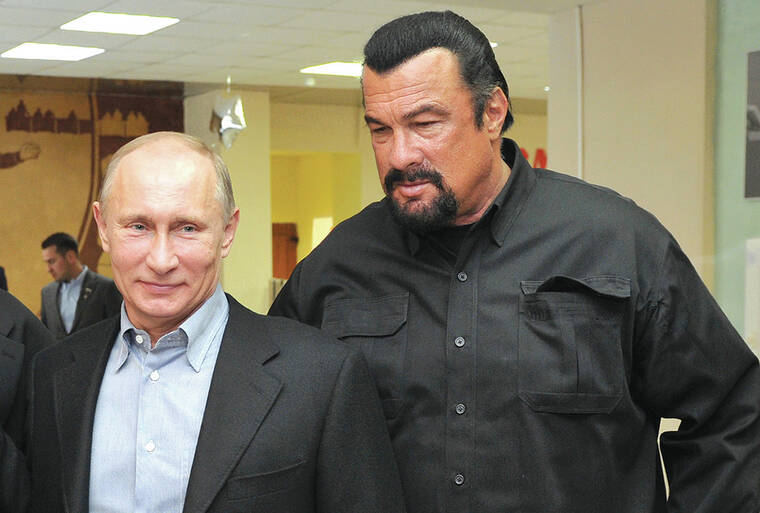
1. Alleged Human Trafficking and Sexual Harassment
Steven Seagal faced serious allegations of human trafficking and sexual harassment in 2010. A 23-year-old woman named Kayden Nguyen filed a lawsuit against the actor, seeking more than one million dollars in damages.
The lawsuit claimed that Seagal kept “sex slaves” on set and engaged in illegal trafficking of females.
Specifically, Nguyen alleged that Seagal had two young female Russian attendants who were expected to cater to his sexual needs 24 hours a day, 7 days a week.
However, the case took an unexpected turn when, three months after filing the suit, Nguyen withdrew her claim without explanation.
This sudden withdrawal left many questions unanswered and added to the controversy surrounding Seagal’s personal conduct.
2. Close Ties to Vladimir Putin and Russian Citizenship
Seagal’s relationship with Russia, particularly with President Vladimir Putin, has been a subject of much discussion.
In November 2016, Seagal was granted Russian citizenship, a move that raised eyebrows internationally.
According to a Russian government spokesman, Seagal had been “asking quite insistently and over a lengthy period to be granted citizenship.”
The actor has made numerous trips to Russia over the years and has met with Putin on several occasions.
Seagal has even gone so far as to state that he “would like to consider Putin as a brother,” although Putin himself has tried to distance himself from these claims.
In addition to his citizenship, Seagal took on a role as a lobbyist for ORSIS, a Russian firearms manufacturer.
In this capacity, he worked to ease U.S. import restrictions on Russian sporting firearms and even collaborated with the company to develop a signature long-range rifle provisionally called “ORSIS by Steven Seagal.”
3. Claimed Fight with the Yakuza
One of the more outlandish claims made by Seagal involves an alleged altercation with the Yakuza, the notorious Japanese criminal organization.
According to Seagal, while he was in Japan, he engaged in an “all-out battle” with the Yakuza.
What makes this claim even more incredible is that Seagal asserted he had help from the Irish mob during this confrontation.
Given the lack of corroborating evidence and the fantastical nature of the claim, many have dismissed this story as a fabrication, likely stemming from Seagal’s penchant for embellishing his life experiences to make himself appear more interesting or dangerous.
4. False Claims of CIA Training and Field Missions
Seagal has made several dubious claims about his involvement with the Central Intelligence Agency (CIA).
He stated in interviews that he not only trained CIA agents in hand-to-hand combat to fight terrorists but also received CIA training himself and occasionally assisted on field missions.
However, these claims were put to the test during a CIA drill, where Seagal’s lack of basic field skills was exposed.
According to reports, when presented with a map and compass – tools essential for navigation in covert operations – Seagal had no idea how to use them.
This revelation cast serious doubt on his claims of CIA involvement and training, suggesting that his statements were likely another instance of exaggeration or outright fabrication.
5. The Gene LeBell Choking Incident
One of the most infamous stories about Seagal involves his encounter with Gene LeBell, a renowned Judo player, friend of Bruce Lee, and one of the original founders of Mixed Martial Arts (MMA).
The incident occurred when Seagal, confident in his Aikido skills, claimed that he couldn’t be choked out.
LeBell, known for his grappling prowess, took up the challenge.
According to the story, LeBell successfully put Seagal in a chokehold.
In response, Seagal allegedly attempted to break free by striking LeBell in the groin.
This tactic proved ineffective, and LeBell maintained the hold until Seagal lost consciousness.
To add further embarrassment to the situation, it’s said that Seagal involuntarily soiled himself during the incident.
This story has become a part of martial arts lore, often cited as an example of the importance of humility and the effectiveness of grappling techniques against traditional martial arts.
6. History of Sexual Harassment Allegations
Seagal’s career has been marred by numerous sexual harassment allegations from women in Hollywood.
One of the most publicized cases involved actress Jenny McCarthy, who recounted an uncomfortable audition experience with Seagal.
According to McCarthy, Seagal asked her to strip for a role, a request she found inappropriate and distressing.
Another incident involved a female costar who reported that Seagal entered her trailer uninvited, watched her brush her teeth, and then made sexual innuendos.
These allegations, along with others, have painted a troubling picture of Seagal’s conduct towards women in the entertainment industry.
Adding to this controversy, Seagal once referred to female reporters as a “bunch of f***ing dirty w*****,” further cementing his reputation for misogynistic behavior and disrespect towards women in professional settings.
7. Worst Saturday Night Live Host
Seagal’s appearance as a host on Saturday Night Live (SNL) in 1991 is infamously remembered as one of the worst in the show’s long-running history.
Multiple cast members and even the show’s creator, Lorne Michaels, have spoken about Seagal’s difficult attitude and refusal to cooperate during his time on the show.
David Spade, a cast member at the time, named Seagal as the person he liked working with the least, describing him as “tough to work with” and unwilling to “play along.”
Tim Meadows, another cast member, criticized Seagal’s approach to comedy, stating, “He had his ideas about what was funny, and you just wanted to go, ‘Well, what have you done that’s funny that I should actually trust what you think?’”
The experience was so bad that during Nicholas Cage’s 1992 appearance on SNL, when Cage joked about being the worst host in the show’s history, Lorne Michaels interrupted to say, “No, no — that would be Steven Seagal.”
This incident has become a notorious part of SNL lore and a significant blemish on Seagal’s public persona.
8. Lies About Racial Background
Throughout his career, Seagal has made various claims about his racial and ethnic background, often changing his story to suit different narratives.
At various times, he has claimed to be of Italian, Japanese, and Russian descent.
However, genealogical research has revealed that Seagal’s actual heritage is primarily Irish and Jewish.
This pattern of falsely claiming diverse ethnic backgrounds has been seen as an attempt by Seagal to make himself appear more exotic or to lend credibility to his martial arts background and cultural interests.
The discrepancies in his claims have led many to question Seagal’s honesty and authenticity.
9. Claims of Multilingual Fluency
Seagal has boasted about his linguistic abilities, claiming fluency in four languages: English, Japanese, Russian, and Italian.
While there’s no doubt about his proficiency in English, evidence for his fluency in the other languages is scarce.
His time spent in Japan does lend some credibility to his claims of Japanese proficiency, although the extent of his fluency is debated.
As for Russian and Italian, there is little to no public evidence of Seagal demonstrating fluency in these languages.
These claims, like many others made by Seagal, have been met with skepticism and are often viewed as exaggerations designed to enhance his image as a worldly and cultured individual.
10. False Claim of Training with Aikido Founder
One of Seagal’s most controversial claims relates to his Aikido training.
He has stated that he received a sponsorship to live and train in Japan with Morihei Ueshiba, the founder of Aikido.
However, this claim is chronologically impossible.
Ueshiba died in 1969 when Seagal would have been only 17 years old.
For Seagal’s story to be true, he would have had to be a young teenager living alone in Japan and missing school.
This fabrication has been particularly damaging to Seagal’s credibility within the martial arts community, where respect for lineage and honest representation of one’s training history is highly valued.
11. Assault on John Leguizamo
In a shocking incident that occurred on the set of the 1996 film “Executive Decision,” Seagal allegedly assaulted his co-star, John Leguizamo.
According to Leguizamo’s account, Seagal announced that he was “in charge” of the set.
This declaration apparently struck Leguizamo as so absurd that he burst out laughing.
Seagal, not appreciating the perceived slight, reportedly approached Leguizamo and punched him hard in the chest.
This incident has been widely circulated as an example of Seagal’s volatile temperament and his tendency to use physical intimidation, even in professional settings.
12. The “Greatest Script Ever” Incident
In another bizarre on-set incident, Seagal once emerged from his trailer after a prolonged absence and made a grandiose announcement to his co-stars.
He claimed to have just read “the greatest script ever written.”
When asked who had written this masterpiece, Seagal replied, “I did.”
This story has been circulated as an example of Seagal’s egotism and his tendency to make outlandish claims about his talents and accomplishments.
It also provides insight into how Seagal’s behavior and attitude have contributed to his reputation in Hollywood.
13. Dubious Claims About Training UFC Fighters
Seagal has made several claims about training high-profile UFC (Ultimate Fighting Championship) fighters, including Anderson Silva and Lyoto Machida.
He has stated that he taught Silva and Machida specific techniques that they later used successfully in their fights.
However, these claims have been met with significant skepticism from the MMA community.
In Machida’s case, there is footage of him using the technique Seagal claimed to have taught him long before their alleged training sessions.
These assertions have been widely dismissed as another example of Seagal attempting to insert himself into the success stories of others and exaggerating his influence in the world of combat sports.
14. Infidelity and Marriage to Kelly LeBrock
Seagal’s personal life has also been a source of controversy.
When he moved to Japan to teach Aikido, he married Miyako Fujitani, the daughter of an Aikido master.
The couple had two children together.
However, Seagal’s marriage to Fujitani ended in divorce after he began an affair with actress and model Kelly LeBrock while still married.
This affair led to Fujitani granting Seagal a divorce.
Seagal and LeBrock subsequently married, but their relationship was also tumultuous and ended in divorce in 1996. This pattern of infidelity and troubled relationships has contributed to Seagal’s controversial public image.
15. Failed Production Company
In the 1990s, Seagal ventured into the business side of the entertainment industry by establishing a production company.
From 1994 to 2000, he co-owned Seagal/Nasso Productions with Julius R. Nasso.
However, this venture proved unsuccessful and was eventually dissolved.
Later, Seagal joined forces with Bing Dang and Joe Halpin to form a new company called Steamroller Productions.
These business ventures demonstrate Seagal’s attempts to expand his influence in Hollywood beyond acting, although with limited success.
16. Directorial Debut Failure
Seagal’s ambitions extended beyond acting to directing, but his foray into this field was not well-received.
His directorial debut, the 1994 film “On Deadly Ground,” was both a critical and commercial failure.
The film, which Seagal also starred in, was an action thriller with an environmental message.
However, it was criticized for its heavy-handed approach to environmentalism and Seagal’s stilted direction.
The film’s poor reception effectively ended Seagal’s directorial career, confining him primarily to acting roles in the future.
17. False Expertise in Swords
Seagal has cultivated an image of himself as an expert in East Asian culture, particularly in relation to martial arts weaponry.
He has amassed a large collection of East Asian swords and has claimed expertise in this area.
According to Seagal, he is regularly called upon by auction houses to authenticate swords.
However, there is no concrete evidence to support these claims.
This assertion of expertise is seen by many as another example of Seagal’s tendency to exaggerate his knowledge and importance in various fields.
18. Unusual Running Style
One of the more lighthearted criticisms of Seagal relates to his running style in action scenes.
Despite his martial arts background and the tough-guy image he portrays, Seagal’s running has been described as awkward and not matching the macho persona he cultivates.
This peculiarity has been noted by fans and critics alike and has become something of a running joke (pun intended) among viewers of his action films.
It’s a small detail, but one that has contributed to the sometimes comical disconnect between Seagal’s desired image and his on-screen reality.
19. Painted-On Hairline
As Seagal aged, observers noted changes in his appearance, particularly regarding his hairline.
In his earlier films, evidence of a receding hairline was visible.
However, in later appearances, his hairline appeared fuller but also somewhat unnatural.
This led to speculation that Seagal was using artificial means to create the appearance of a fuller head of hair, possibly including painting on his hairline.
This attention to his appearance has been seen as indicative of Seagal’s concern with maintaining a youthful, virile image, even as he aged.
20. Law Enforcement Involvement
Seagal’s involvement with law enforcement has been a significant and controversial aspect of his public persona.
He has served as a reserve deputy chief in the Jefferson Parish, Louisiana, Sheriff’s Office, where he participated in actual law enforcement activities, including drug raids.
This real-world experience formed the basis for his reality TV series “Steven Seagal: Lawman,” which aired from 2009 to 2014. The show followed Seagal’s activities as a reserve deputy sheriff, showcasing his involvement in various law enforcement operations.
Additionally, Seagal has trained with the Navajo Nation police, further expanding his law enforcement connections.
However, his involvement in real police work has been criticized by some as potentially dangerous and inappropriate for a civilian, regardless of his martial arts background.
21. Multiple Citizenships
Seagal holds citizenship in three countries: the United States, Serbia, and Russia.
His American citizenship is by birth, while his Serbian and Russian citizenships were granted later in life.
The Serbian citizenship was awarded in 2016, reportedly for his work in promoting the country.
His Russian citizenship, also granted in 2016, came after years of praising Russian President Vladimir Putin and expressing support for Russian policies.
These multiple citizenships reflect Seagal’s international connections and his efforts to establish himself as a global figure, though they have also raised questions about his loyalties and motivations.
22. Aikido Career in Japan
Seagal’s martial arts career, particularly in Aikido, is a central part of his identity.
He moved to Japan in the early 1970s to further his Aikido training and became the first foreigner to operate an Aikido dojo in Japan.
This was a significant achievement in the martial arts world, especially given the traditional nature of Japanese martial arts schools.
During his time in Japan, Seagal also served as an Aikido instructor for the Japanese police, further cementing his credentials in the martial arts community.
These experiences in Japan formed the foundation of Seagal’s martial arts expertise and significantly influenced his later career in action films.
23. Music Career
Beyond his work in film and martial arts, Seagal has pursued a career in music.
He has released several albums, primarily in the blues and world music genres.
His debut album, “Songs from the Crystal Cave,” was released in 2005 and featured a mix of blues, pop, and world music.
He followed this with “Mojo Priest” in 2006, which leaned more heavily into the blues genre.
Seagal is also an accomplished guitarist, often incorporating his musical performances into his other pursuits.
While his music career hasn’t achieved the same level of recognition as his film work, it demonstrates Seagal’s diverse interests and his desire to be seen as a multi-talented artist.
24. Training Celebrities in Martial Arts
Seagal’s martial arts expertise has attracted the attention of various celebrities over the years.
One of the most notable examples is his training of Sean Connery, the legendary James Bond actor.
Seagal reportedly worked with Connery to improve his martial arts skills for film roles.
Other celebrities who have trained with Seagal include James Caan and, more controversially, Anderson Silva, the former UFC Middleweight Champion.
These high-profile training sessions have helped to bolster Seagal’s reputation as a martial arts expert, although the extent and effectiveness of this training have been debated, particularly in the case of professional fighters like Silva.
25. Author of Books on Eastern Philosophy
In addition to his other pursuits, Seagal has authored books on Eastern philosophy and spirituality.
These writings explore topics such as Zen Buddhism, martial arts philosophy, and the pursuit of inner peace.
Seagal’s interest in Eastern spirituality is longstanding, dating back to his time in Japan and his deep involvement with Aikido, which has strong philosophical and spiritual components.
His books aim to share these Eastern concepts with a Western audience, drawing on his experiences and studies.
However, like many of Seagal’s endeavors, his writings on Eastern philosophy have been met with mixed reactions.
While some appreciate his efforts to bridge Eastern and Western thought, others question the depth and authenticity of his understanding.
Nevertheless, these books represent Seagal’s attempt to position himself as not just an action star, but also a spiritual thinker and guide.
26. Animal Rights and Environmental Activism
Seagal has been involved in various animal rights and environmental causes throughout his career.
He has spoken out against animal cruelty and has been a vocal supporter of organizations working to protect wildlife.
His environmental activism was notably featured in his film “On Deadly Ground,” which, despite its poor reception, attempted to raise awareness about environmental issues, particularly those related to the oil industry.
Seagal has also been involved in campaigns for clean energy and conservation.
While his approach to these issues has sometimes been criticized as heavy-handed or simplistic, his commitment to these causes appears genuine and long-standing.
27. Seventh-Degree Black Belt in Aikido
Seagal’s martial arts credentials are centered around his high rank in Aikido.
He holds a 7th-degree black belt in the art, which is a significant achievement.
In Aikido, as in many Japanese martial arts, ranks above 5th degree are considered master-level and are awarded not just for technical skill, but also for contributions to the art and years of dedicated study.
Seagal’s high rank reflects not only his technical proficiency but also his long-term commitment to Aikido and his role in promoting the art, particularly in the West.
This rank has been a cornerstone of Seagal’s martial arts credibility and a major factor in his action movie career.
28. Exotic Pet Ownership
Among Seagal’s eccentricities is his penchant for exotic pets.
Most notably, he owns a pet tortoise named Tootsie.
While this might seem like a harmless quirk, the ownership of exotic pets can be controversial due to concerns about animal welfare and the impact on wild populations.
Seagal’s choice of a tortoise as a pet aligns with his professed love for animals and his environmental activism, as tortoises are generally long-lived and require specialized care.
This aspect of Seagal’s life offers a glimpse into his personal interests beyond his public persona.
29. Energy Drink Endorsements and Personal Brand
Seagal has leveraged his celebrity status to venture into product endorsements, particularly in the energy drink market.
He has appeared in commercials for energy drinks and even launched his own line of energy beverages.
This move into the beverage industry reflects Seagal’s efforts to diversify his brand beyond film and martial arts.
The energy drink market, with its associations with vitality and performance, aligns well with Seagal’s action hero image.
However, like many celebrity-endorsed products, the success and quality of these drinks have been subjects of debate.
30. Weapons Expertise
Beyond his martial arts skills, Seagal is known for his proficiency with various weapons, particularly firearms.
This expertise has been prominently featured in many of his action films, where he often performs complex weapons handling.
Seagal’s weapons training extends beyond just theatrical use; he has claimed to have extensive real-world firearms training and has been involved in the development of firearms, as evidenced by his collaboration with ORSIS.
This weapons expertise adds another layer to Seagal’s tough-guy image and has been a significant aspect of his appeal in action movies.
31. Cameo Appearances in Rap Music Videos
In an interesting crossover between his film career and the music industry, Seagal has made cameo appearances in several rap music videos.
This unexpected foray into hip-hop culture demonstrates Seagal’s pop culture reach and his willingness to engage with different entertainment mediums.
These appearances have often played on his tough-guy image and martial arts skills, integrating them into the aesthetic of rap videos.
While some might see these cameos as incongruous with Seagal’s usual persona, they showcase his versatility and his recognition in diverse cultural spheres.
32. Training with Brazilian Jiu-Jitsu Masters and Shaolin Kung Fu Founder
Despite his primary focus on Aikido, Seagal has explored other martial arts disciplines.
He has trained with renowned Brazilian Jiu-Jitsu masters, showcasing an interest in grappling arts that are quite different from Aikido’s primarily standing techniques.
Additionally, Seagal has claimed to have trained with the founder of Shaolin Kung Fu, Shi Yan Ming.
This eclectic martial arts background has been both a point of interest and controversy.
While it demonstrates Seagal’s broad interest in various fighting styles, some have questioned the depth of his training in these additional disciplines, especially given his strong Aikido foundation.
33. Early Martial Arts Training
Seagal’s journey in martial arts began at a remarkably young age.
He started his training at seven years old, which is earlier than many martial artists begin their formal study.
This early start laid the foundation for his lifelong dedication to martial arts, particularly Aikido.
Beginning at such a young age allowed Seagal to develop a deep understanding of martial arts principles and body mechanics, which would later influence his unique fighting style in films.
This early initiation into martial arts is often cited as a key factor in Seagal’s rapid progression and eventual mastery in Aikido.
34. Move to Japan in Early 1970s
In the early 1970s, Seagal made a pivotal decision to move to Japan to further his martial arts training.
This move was significant not only for his martial arts career but also for shaping his overall persona.
Living in Japan immersed Seagal in Japanese culture, language, and philosophy, elements that would become integral to his public image.
During his time in Japan, Seagal studied intensively under various Aikido masters, honed his language skills, and began to develop the enigmatic persona that would later define his Hollywood career.
This period in Japan is often romanticized in Seagal’s personal narrative, forming a crucial part of his mystique as a martial artist and cultural figure.
35. Acting Debut in “Above the Law” (1988)
Seagal’s transition from martial arts instructor to Hollywood action star began with his debut film, “Above the Law,” released in 1988. This film introduced Seagal’s unique blend of martial arts action and tough-guy charisma to mainstream audiences.
In the movie, Seagal played Nico Toscani, a former CIA agent turned Chicago cop, a role that established the template for many of his future characters.
The film was a moderate success and launched Seagal’s career in Hollywood.
It showcased his Aikido skills in a cinematic context, bringing a fresh style of martial arts to American action films.
“Above the Law” set the stage for Seagal’s rise as an action movie star in the late 1980s and early 1990s.
36. Performing His Own Stunts
A notable aspect of Seagal’s film career is his insistence on performing his own stunts.
This commitment to authenticity in action scenes has been a point of pride for Seagal and a selling point for his films.
By doing his own stunts, Seagal has been able to showcase his genuine martial arts skills on screen, lending credibility to his action sequences.
This practice has also contributed to the distinct style of his fight scenes, which often feature more realistic and brutal techniques compared to the more choreographed styles of other action stars.
However, performing stunts also comes with risks, and there have been reports of injuries and on-set incidents related to Seagal’s hands-on approach to action scenes.
37. Awards and Recognition
Throughout his career, Seagal has received various forms of recognition for his contributions to film and martial arts.
He has been awarded the Martial Arts Movie Lifetime Achievement Award, acknowledging his impact on the genre of martial arts films.
This award recognizes not just his performances in movies but also his role in popularizing Aikido and other martial arts through his films.
On the other end of the spectrum, Seagal has also received a Golden Raspberry Award for Worst Actor, a dubious honor that reflects the often mixed reception of his acting performances.
These contrasting accolades illustrate the polarizing nature of Seagal’s career and public persona.
38. Support for Veterans’ Causes
Seagal has been involved in various initiatives supporting military veterans.
This aspect of his public work aligns with the patriotic themes often present in his films and his overall tough-guy image.
His support for veterans has included participating in events, making donations, and using his platform to raise awareness about issues affecting former service members.
This commitment to veterans’ causes adds a dimension of social responsibility to Seagal’s public image, though like many of his endeavors, the extent and impact of his involvement have been subjects of discussion.
39. Ongoing Aikido Seminars
Despite his diverse career in entertainment and business, Seagal has maintained his connection to Aikido by continuing to teach seminars worldwide.
These seminars allow Seagal to share his martial arts knowledge and philosophy with students around the globe.
They serve multiple purposes: maintaining Seagal’s credentials as a martial arts expert, providing a platform for him to engage with fans, and continuing the spread of Aikido.
These seminars often attract a mix of martial arts enthusiasts and fans of Seagal’s film work, bridging his various public personas.
40. Birth and Early Life
Steven Frederic Seagal was born on April 10, 1952, in Lansing, Michigan.
His father, Samuel Seagal, was a high school math teacher, and his mother, Patricia, was a medical technician.
Seagal’s early life in Lansing was relatively ordinary, with little indication of the colorful and controversial career that would follow.
The family moved to Fullerton, California, when Seagal was a child, which is where he first began his martial arts training.
This Midwestern origin and subsequent move to California form an interesting contrast with the international, especially Asian, influences that would later shape Seagal’s public persona and career.