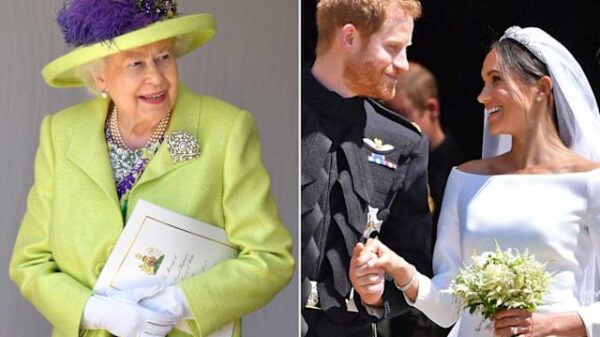
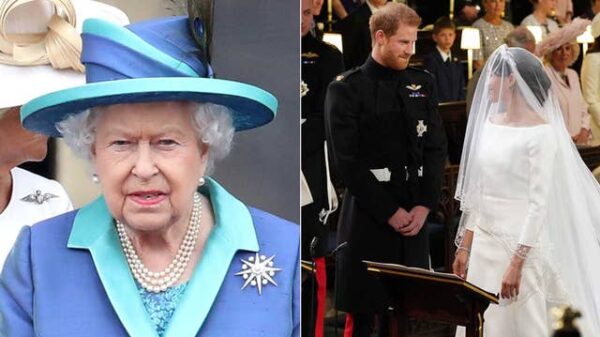


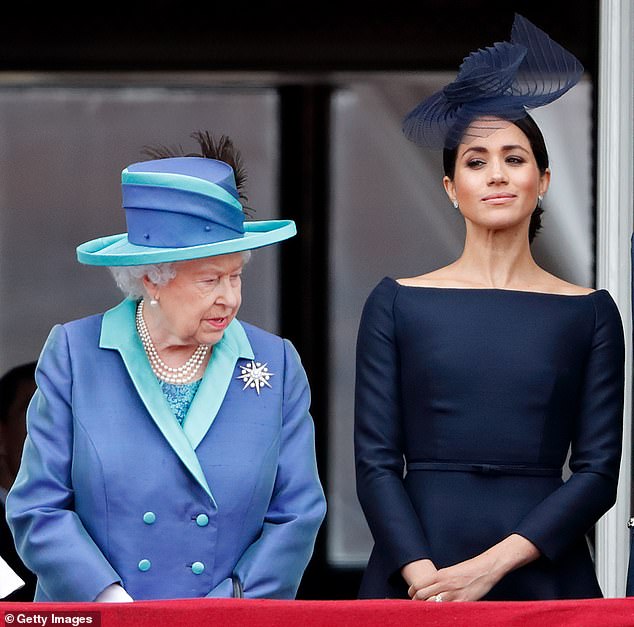
According to an upcoming biography, Queen Elizabeth II had her reservations regarding Prince Harry‘s intense affection for Meghan Markle.
This revelation comes as part of the new book, “Elizabeth: An Intimate Portrait,” authored by Gyles Brandreth, a renowned broadcaster and family friend of the royals.
Brandreth notes that the Queen’s concern about Harry being “perhaps a little over-in-love” with Meghan was among her few remarks regarding the Duchess of Sussex.
The author emphasized that this reflection didn’t translate into any overt disapproval of Meghan, underscoring the Queen’s genuine fondness for her.
When Harry first announced his engagement to Meghan, the late monarch was reportedly overjoyed.
She did her utmost to welcome Markle into the royal family, making every effort to ensure her comfort and acceptance.
Brandreth reveals that the Queen openly expressed her delight about the marriage to numerous people within her circle.
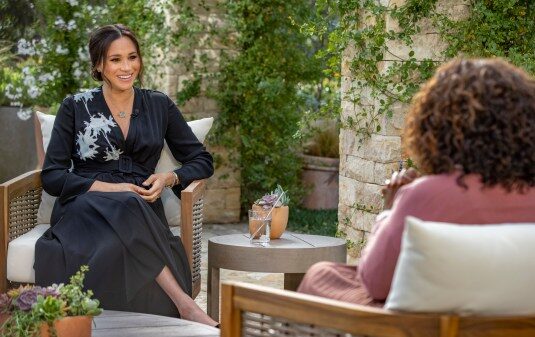
Interestingly, the biography indicates that the Queen remained unfazed by the contentious interview Harry and Meghan gave to Oprah Winfrey, which stirred considerable media uproar.
Brandreth emphasizes that the Queen cared more for Harry’s emotional well-being than the scandalous nature of media portrayals, suggesting that she viewed the interview as mere “television nonsense.”
In the days following Harry’s move to California, Brandreth recalls the Queen’s concern for her grandson’s adjustment to his new life.
She hoped he would “find his feet” in this new environment and engage in meaningful activities.
This insight into the Queen’s caring nature paints a picture of a grandmother prioritizing family over the media frenzy.
The biography further reveals that in her final years, the Queen faced significant health struggles, with Brandreth alluding to a diagnosis of myeloma, a form of bone marrow cancer.
This condition could explain her reported fatigue and mobility challenges, which were evident in the later stages of her life.
Despite her passing in September at the age of 96, the insights shared in this biography continue to reflect the complexities of royal relationships, particularly regarding Harry and Meghan.
The revelations present a human side to the public’s perception of the monarchy, showcasing the Queen’s personal investment in her grandson’s happiness.
Amid allegations of Meghan’s supposed bullying of royal staff—a claim that she has consistently denied—the Queen’s worry for Harry’s well-being became apparent.
These allegations heightened the scrutiny Meghan faced, leading to wider questions about the dynamics within the royal family.
During a notable first meeting, the Queen assured Meghan that she could maintain her acting career, saying, “You can carry on being an actress if you like – that’s your profession, after all.”
Meghan, however, gracefully opted to step back from her career to devote herself to her royal responsibilities, pledging not to disappoint the Queen regarding their shared commitment to the Commonwealth.
The biography also sheds light on family dynamics, recounting moments when other royals expressed their views on Harry and Meghan’s choices, including their decision to engage with Oprah.
While some royal family members critiqued the Sussexes’ media engagements, the Queen demonstrated a more relaxed attitude, perhaps reflecting her vast experience and understanding of public life.
Ultimately, “Elizabeth: An Intimate Portrait” portrays the late Queen as a figure marked by deep familial love.
Her worries for Prince Harry, following his marriage to Meghan, reveal a tender side of her personality, one that cared profoundly for the emotional health of her grandson amid a tumultuous era for the royal family.
Why Queen Elizabeth disliked Meghan …
Prince Philip saw it coming and warned Her Majesty from the start.
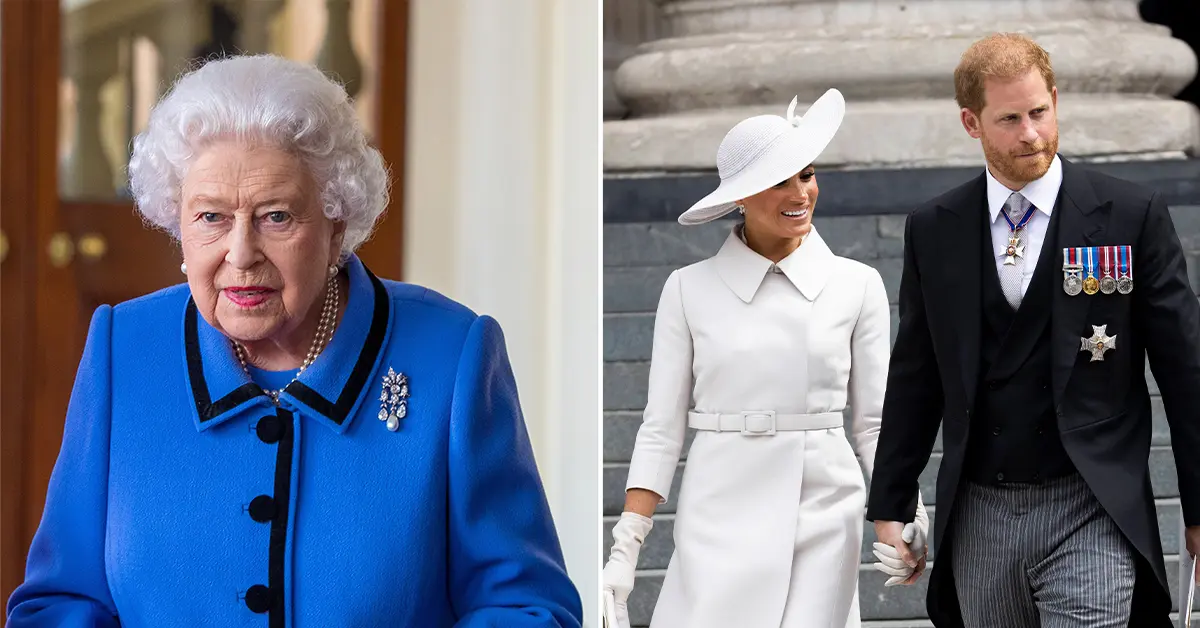
The Early Days: First Impressions and Royal Welcome (2016-2017)
The relationship between Meghan Markle and the British Royal Family began with a surprisingly informal introduction to Queen Elizabeth II in October 2016, just months after she started dating Prince Harry.
The meeting, which took place at Royal Lodge, came as something of a surprise to Meghan herself.
As she later revealed in the Netflix documentary “Harry & Meghan,” the encounter was remarkably impromptu: “There wasn’t like some big moment of, ‘now you’re going to meet my grandmother.’ I didn’t know I was going to meet her until moments before.
We were in the car and we were going to Royal Lodge for lunch, and he’s like, ‘Oh, my grandmother’s here, we’re going to meet her after church.’”
The moment was made more memorable by Harry’s last-minute query about royal protocol.
“And I remember we were in the car driving up and he’s like, ‘You know how to curtsy, right?’ And I just thought it was a joke,” Meghan recalled.
This candid revelation offered a glimpse into the less formal side of royal introductions, though it would later become clear that such protocols held deep significance within the institution.
Initially, the Queen’s response to Meghan was notably positive.
According to royal correspondent Richard Eden, courtiers reported that Elizabeth found Meghan to be “a breath of fresh air and a great asset” to the monarchy.
This warm welcome was demonstrated through an unprecedented gesture when the Queen invited Meghan to join the royal family at Sandringham for Christmas in 2017, months before her wedding to Harry.
This invitation was particularly significant as it broke with tradition – typically, only married partners were included in royal Christmas celebrations.
The Queen’s approval was further evidenced in her 2017 Christmas broadcast, where she made specific mention of “new members” joining the family, widely interpreted as a welcoming nod to Meghan.
However, even as the Queen extended these warm gestures, Prince Philip maintained a more cautious stance.
According to royal biographer Ingrid Seward, Philip saw concerning parallels between Meghan and another American divorcée who had married into the royal family – Wallis Simpson.
This comparison led Philip to privately refer to Meghan as “DoW” (Duchess of Windsor), though he never used this nickname to her face.
As Seward explained, “I think Prince Philip was very canny about people and he didn’t always see the bad in them, he tried to see the good in them.
I think he just couldn’t get away from the fact [of the] similarities between Meghan and Harry and Edward and Mrs Simpson.”
These early days represented a period of both promise and underlying tension, with the Queen’s public embrace of Meghan standing in contrast to Philip’s private reservations.
The stage was being set for what would become one of the most dramatic chapters in modern royal history.
Wedding Preparations and Growing Tensions (2018)
The lead-up to Harry and Meghan’s 2018 wedding revealed the first significant cracks in what had appeared to be a smooth integration into the royal family.
According to Katie Nicholl’s book “The New Royals,” tensions emerged during the wedding preparations, particularly during a menu tasting at Windsor Castle that led to a notable confrontation.
During this tasting session, Meghan reportedly became “quite upset” with a staff member over a dish that was meant to be vegan but apparently tasted of egg.
The exchange became heated enough that Queen Elizabeth herself felt compelled to intervene.
According to Nicholl’s source, “Suddenly the Queen walked in and said, ‘Meghan, in this family we don’t speak to people like that.’” This direct rebuke from the monarch marked one of the first documented instances of friction between Meghan and the royal establishment.
The choice of wedding dress also became a point of contention. Sources close to the palace revealed that Queen Elizabeth was “surprised” by Meghan’s decision to wear pure white on her wedding day.
“Perhaps it’s a generational thing, but she believes if you’ve been married before, you wear off-white on your wedding day, which is what the Duchess of Cornwall did,” a source told Nicholl.
This detail, while seemingly minor, reflected deeper generational and cultural differences in approaches to royal tradition.
Further complications arose when Meghan reportedly rejected the Queen’s suggestion that Sophie, the Duchess of Edinburgh (then Countess of Wessex), should guide her through the transition into royal life.
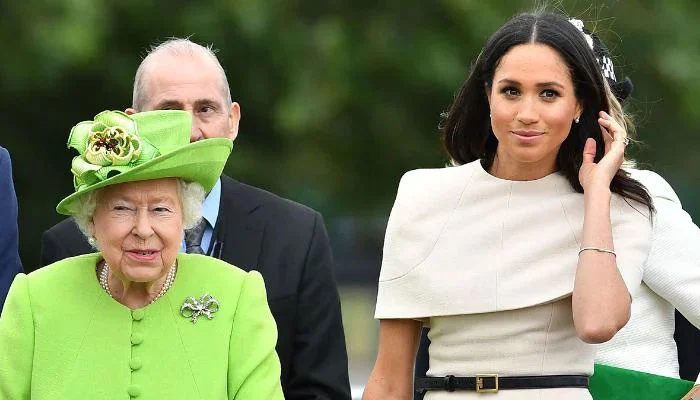
This decision was said to have taken the Queen aback, as Sophie had successfully navigated a similar transition from civilian to royal life and could have provided valuable insight. The matter of the royal tiara also became a source of tension, though specific details about this dispute vary among sources.
What is clear is that the Queen had reservations about Meghan’s approach to these traditional royal elements of the wedding preparations.
According to The Mail, staff began to form the opinion that Meghan “may not have wanted to make a success of her life in Britain” even during these early stages, as she appeared to be “actively seeking reasons to be unhappy or resentful.” These impressions would later seem prophetic as events unfolded.
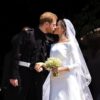
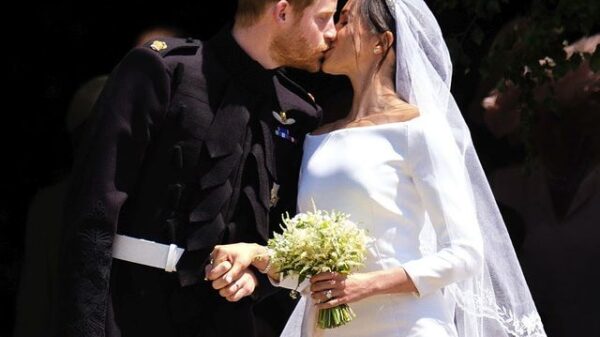
Despite these undercurrents of tension, the wedding itself was a spectacular affair at St. George’s Chapel, Windsor Castle, with King Charles stepping in to walk Meghan down the aisle after her own father was unable to attend.
This gesture seemed, at the time, to symbolize the royal family’s acceptance of their newest member, even as behind-the-scenes friction suggested challenges ahead.
Life Within the Royal Family (2018-2020)
One of the most revealing aspects of Meghan’s early life within the royal family centered around the couple’s living arrangements, which became a source of unexpected tension.
According to Robert Jobson’s book “Catherine, The Princess of Wales,” the disparity between the residences of the two royal brothers became a point of contention almost immediately.
Prince Harry and Meghan were living in Nottingham Cottage (affectionately known as “Nott Cott”), a modest two-bedroom, one-bathroom residence on the grounds of Kensington Palace.
While still on palace grounds, this was in stark contrast to William and Kate’s Apartment 1A, which boasted 20 rooms.
According to Jobson, this difference in accommodation did not go unnoticed by Meghan.
“When they went to have drinks at William and Catherine’s palatial apartment, she was apparently ‘taken aback’ at the disparity between the brothers,” Jobson wrote.
“Meghan understood that William was above her husband in the royal pecking order as the heir to the throne, but she thought Harry was also a royal prince, so he deserved more materially.” The author noted that Meghan was “piqued by the disparity.”
Even Harry himself acknowledged the modest nature of their first home together.
In his memoir “Spare,” he wrote: “I was excited to welcome Meg to my home, but also embarrassed. Nott Cott was no palace.”
This situation was eventually addressed when Queen Elizabeth gifted the couple Frogmore Cottage, a more substantial five-bedroom property, after their wedding.
The couple spent £2.4 million (approximately $3 million) renovating the property. During this period, the relationship between Meghan and the senior royals began to show increasing signs of strain.
Queen Elizabeth’s initial warmth began to cool as concerns about Meghan’s behavior and attitude grew closer to the wedding.
Palace sources indicated that the Queen was particularly troubled by what she perceived as Meghan’s difficulty in adapting to royal protocols and traditions. The situation was complicated by Prince Philip’s continued wariness.
While he maintained a public face of support, his private concerns about the parallels between Meghan and Wallis Simpson never fully subsided.
These concerns were shared with the Queen, with Philip reportedly warning his wife to be cautious in her dealings with their new granddaughter-in-law. By late 2019, the strain was becoming increasingly apparent.
Staff members reported growing tensions, and there were increasing signs that the couple was struggling to find their place within the rigid structure of the royal institution.
The distance between Meghan and other family members, particularly William and Kate, appeared to grow, with various reports of friction and misunderstandings.
The couple’s unorthodox approach to royal duties and their desire for a more independent role began to cause friction with the palace establishment.
Their requests for a different kind of working arrangement were met with resistance from an institution steeped in tradition and protocol, setting the stage for what would become a dramatic breaking point in early 2020.
The Breaking Point: Royal Exit (2020)
The culmination of mounting tensions came in January 2020 when Harry and Meghan stunned both the royal family and the world with their announcement that they would step back as “senior” royals.
The manner of their announcement – made via Instagram without consulting other members of the royal family – caused particular distress among the senior royals.
Prince Philip’s reaction to the news was especially dramatic.
According to Christopher Andersen’s book “Brothers and Wives: Inside the Private Lives of William, Kate, Harry and Meghan,” Philip was “furious, deeply hurt, spitting blood” when he learned of the announcement.
Despite not being familiar with Instagram as a platform, Philip immediately grasped the significance of the public declaration and its implications for the monarchy.
The book reveals that Philip went directly to the Queen, reportedly shouting “this shows a complete lack of respect.” In a particularly poignant moment, Philip reportedly confided to one of his closest aides: “It appears as if, we were wrong about her all along.”
This marked a significant shift from his earlier cautious but measured approach to Meghan. The timing and manner of the announcement particularly troubled the royal family.
Buckingham Palace’s response was unusually swift and blunt, expressing “disappointment” that the couple had chosen to make their decision public without prior consultation.
According to palace sources, Prince Charles’s reaction was described as “frightening” by his staff, and he reportedly had a phone conversation with Harry telling him to “try and fix this.”
Queen Elizabeth’s response to the departure was complex. While she continued to publicly support her grandson and his wife, private accounts suggest she was deeply troubled by their decision.
She particularly struggled to understand their choice to leave the country entirely, and sources close to the monarch revealed she was unable to comprehend why they couldn’t continue their royal duties while pursuing their own interests, as other family members had done.
The subsequent period was marked by a series of challenging negotiations about the terms of their departure, dubbed “Megxit” by the press.
The Queen took a firm stance on certain issues, particularly regarding the use of the “Sussex Royal” brand and their ability to represent the monarchy in any capacity.
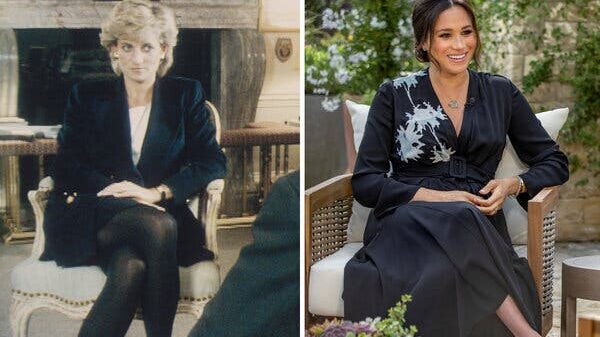
The tensions would only escalate further with the couple’s March 2021 interview with Oprah Winfrey, which took place while Prince Philip was in hospital.
During this interview, Harry and Meghan made several explosive claims about the royal family, including allegations of racism and lack of support for Meghan’s mental health struggles.
The timing of this interview, and Meghan’s press release just before Prince Philip’s funeral announcing she would be watching from home, further strained relationships with the royal family.
The exit marked a decisive turning point in modern royal history, creating ripples that would continue to affect family relationships up until Queen Elizabeth’s death in 2022.
Final Chapter: The Queen’s Last Days (September 8, 2022)
The events surrounding Queen Elizabeth’s passing revealed the lasting impact of the preceding years’ tensions.
On September 8, 2022, as concerns grew about the Queen’s health, a dramatic series of events unfolded that would highlight the continuing strain in family relationships.
The day began with Prince Harry and Meghan coincidentally being in the UK for various engagements.
When news of the Queen’s declining health emerged, King Charles (then Prince Charles) made a crucial phone call to his son that would become a subject of controversy.
As detailed in Harry’s memoir “Spare,” Charles informed him that he was welcome at Balmoral but explicitly stated that Meghan should not come.
Harry recounted the tense exchange in his book: “He said I was welcome at Balmoral, but he didn’t want… her.
He started to lay out his reason, which was nonsensical, and disrespectful, and I wasn’t having it.” The conversation became heated, with Harry defending his wife: “Don’t ever speak about my wife that way.”
According to Harry, Charles then attempted to explain, stammering “apologetic, saying he simply didn’t want a lot of people around. No other wives were coming, Kate wasn’t coming, he said, therefore Meg shouldn’t.”
The timeline of that day reveals a chaotic sequence of events:
- At 12:50 PM, Buckingham Palace announced that Prince William, Prince Andrew, Prince Edward, and Sophie had begun their journey to Scotland.
- Queen Elizabeth passed away at 15:10 (3:10 PM), with only Princess Anne present. Notably, Charles had momentarily stepped out to gather mushrooms and clear his mind when his mother passed.
- Charles learned of her death while driving back to Balmoral after his senior aide received a call. He pulled over, and for the first time was addressed as ‘Your Majesty’ – marking his new status as King.
- William’s party landed at 3:50 PM, 40 minutes after the Queen’s passing. With William driving, they reached Balmoral at 5:06 PM.
- Harry departed from Luton airport on a private jet around 5:30 PM, significantly later than the others.
- The public announcement of the Queen’s death was made at 6:30 PM while Harry was still airborne.
Harry recalled discovering his grandmother’s passing through a BBC news update and a message from Meghan: “It was a message from Meg: ‘Call me when you get this.’ I looked at the BBC website.
My grandmother had died. My father was King,” he wrote in “Spare.” Kate’s absence that day was also subject to much speculation, with rumors suggesting it might have been influenced by Charles.
However, royal author Robert Hardman clarified in his book “Charles III: New King, New Court.
The Inside Story” that it was Kate’s own decision to stay behind with her children, Prince George, Princess Charlotte, and Prince Louis, as they started at Lambrook School that day.
She wanted to provide stability for them during this significant transition.
These final moments and the way they unfolded would serve as a poignant capstone to the complex relationship between the Sussexes and the royal family during Queen Elizabeth’s final years.
Legacy and Reflections
The final chapter of Queen Elizabeth’s relationship with Meghan Markle and Prince Harry leaves a complex legacy that reveals deep divisions within the royal family and raises questions about the monarchy’s ability to adapt to modern times.
According to various sources, the Queen’s final thoughts about Meghan and the situation were far more critical than her public stance suggested.
In her final months at Balmoral, Elizabeth reportedly made some surprisingly frank comments about the relationship.
According to sources reported in the Spectator, during a reception at Balmoral in August 2022, just weeks before her death, the Queen described Harry’s meeting with Meghan as a “complete catastrophe” to a small group during pre-dinner drinks.
The source noted, “Everybody’s eyebrows hit the ceiling” at her unusually direct language. Prince Philip’s lasting concerns about Meghan proved particularly prophetic.
His comparison of Meghan to Wallis Simpson, reflected in his private nickname for her as “DoW” (Duchess of Windsor), highlighted the historical parallels that worried the older generation of royals.
As Ingrid Seward wrote in her book, “From the moment he detected her apparent similarity to Wallis, he referred to her as DoW.”
This comparison became increasingly relevant as events unfolded, with both American divorcées being seen as disruptive forces within the royal family.
The Wallis Simpson parallels became even more pronounced after Harry and Meghan’s departure to America.
Like Edward VIII and Wallis Simpson before them, the couple chose a life in exile, though under very different circumstances.
The historical echoes were not lost on the royal family, with both Philip and the Queen reportedly discussing these similarities in private.
In his memoir “Spare,” Harry attempted to contextualize his relationship with his grandmother in his final reflections: “I’ll forever support my Queen, my Commander in Chief, my Granny. Even after she’s gone,” he wrote.
However, he also noted the institutional barriers that prevented family support during crucial moments: “My problem has never been with the monarchy, nor the concept of monarchy. It’s been with the press and the sick relationship that’s evolved between it and the Palace.”
The Queen’s final years were marked by this family discord, with sources suggesting she was particularly “upset” by the couple’s explosive claims against the royals in their various interviews.
The timing of their Oprah interview while Prince Philip was in hospital, and subsequent media appearances, reportedly deeply troubled her.
Robert Hardman’s book revealed that although the Queen initially championed Meghan and had “high hopes for what the American actress might be able to achieve with Harry for the youth of the Commonwealth,” these hopes gradually gave way to disappointment.
The Queen reportedly remarked in her “clipped way” that perhaps Harry had been “too in love” with the American actress, suggesting she saw this intense relationship as part of the problem.
The legacy of this period continues to influence the monarchy under King Charles III, with the relationships between Harry, Meghan, and the rest of the royal family remaining strained.
The absence of Meghan from King Charles’s coronation and other significant royal events suggests that the divisions exposed during Queen Elizabeth’s final years persist, leaving a lasting impact on the modern royal family’s dynamics.
This complex chapter in royal history serves as a testament to the challenges faced by the monarchy in balancing tradition with modernization, and the personal cost of public duty – themes that defined much of Queen Elizabeth’s reign and continue to resonate in its aftermath.