





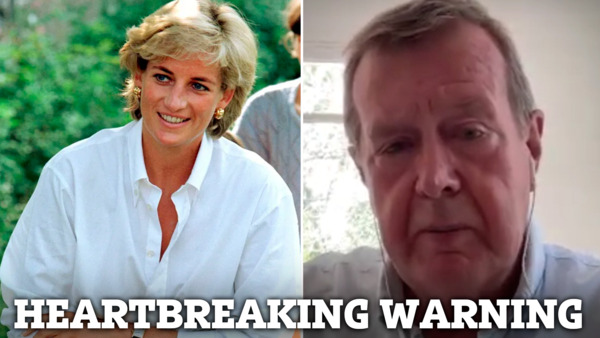
Ken Wharfe served as Princess Diana‘s personal protection officer from 1987 to 1993.
He was with her through some of the most turbulent years of her marriage and her life.
He understood the specific security risks she faced as one of the most recognisable and pursued people in the world.
When he eventually spoke publicly about the circumstances of her death in the Paris tunnel in August 1997 — four years after he had left her protection detail — he identified three specific security failures that, in his professional judgment, had cost Diana her life.
He also said he had warned her about her vulnerability.
She had chosen to live with it anyway.
Wharfe’s account, reported by Today.com and MEAWW News, is grounded in professional specificity rather than speculation.
He was not a conspiracy theorist offering a general critique of Palace negligence.
He was a trained protection officer who had spent years thinking about exactly the kind of threats that materialised in the Pont de l’Alma tunnel, and who could identify, from his professional background, the precise points at which the system failed on the night of August 30-31, 1997.
The three failures Wharfe identified are: the absence of a dedicated, vetted security driver; the lack of pre-planned escape routes from the Ritz Hotel; and the failure to manage or anticipate the presence of pursuing paparazzi photographers in the immediate vicinity of the vehicle.
Each of these failures, in isolation, represented an increased risk.
Together, in the specific conditions of that night, they were fatal.
The driver question is the most heavily documented.
Henri Paul, who drove the Mercedes in the tunnel, was employed as a security manager at the Ritz Hotel.
He was not Diana’s designated protection driver.
He was not, in Wharfe’s professional assessment, trained to the standard required for the protection of a former member of the Royal Family in a high-profile, high-risk environment.
Post-mortem toxicology found alcohol in his system as well as prescription medication — a combination that significantly impairs both reaction time and judgment.
Had Diana been travelling with a protection officer and a vetted, trained driver, as was the standard when Wharfe was responsible for her security, Henri Paul would not have been behind the wheel.
The second failure — the absence of a route plan from the Ritz — is less discussed but equally significant in professional security terms.
When a high-profile individual leaves a location with known media attention, the standard protection protocol involves pre-planning of exit routes, timing, and counter-surveillance measures designed to reduce the gap between the departure point and a secure destination.
The improvised nature of the departure from the Ritz on the night of August 30 — the use of a decoy vehicle, the last-minute change of plan, the decision to take an unconventional route — represented an improvisation that was inconsistent with professional protection standards.
The paparazzi management failure is the one that generated the most immediate public discussion after Diana’s death.
Pursuing photographers, some on motorcycles, followed the Mercedes from the Ritz.
The driver’s attempt to outrun them on the roads of Paris contributed directly to the speed at which the vehicle entered the tunnel.
A protection team operating at professional standards would have had protocols for managing paparazzi pursuit — protocols that would not have involved a high-speed chase through Paris at night.
Wharfe’s statement that he had warned Diana directly about her vulnerability is one of the most significant elements of his account.
By the time of her death, Diana was travelling without Metropolitan Police protection, having made the decision after her separation from Charles to reduce her official security arrangements.
She had various personal security staff at different points, but she was not protected to the standard she had been during her marriage.
Wharfe, who had maintained contact with her after leaving her detail, had expressed his concern about this arrangement.
She understood the risk and accepted it as the cost of a more independent life.
The MEAWW account of Wharfe’s analysis notes that his professional judgment on the three failures is consistent with the findings of the French investigation and with the conclusions of the British inquest.
Both investigations identified the crash as the result of negligent driving in the context of paparazzi pursuit, without finding evidence of a deliberate conspiracy.
Wharfe’s contribution is not to the conspiracy question but to the more specific question of how a woman who had once been protected to the highest professional standards came to be in the back of a car driven by an unvetted driver on an unplanned route with no protection officer present.
The answer to that question involves a series of decisions that Diana herself made in the final years of her life.
She wanted freedom.
She wanted to be able to move through the world without the apparatus of official protection — which was also the apparatus of official surveillance and control.
She made that trade-off consciously and deliberately.
Wharfe understood it.
He had watched her make it.
His warning was offered in the knowledge that she might not take it, and it was not taken.
The professional sadness of Wharfe’s account is distinct from the personal grief of those who loved Diana.
He is not primarily mourning a friend, though he clearly respected her.
He is a professional describing a professional failure — identifying, with the precision of training and experience, exactly where the system broke down and exactly what the consequences were.
His account is, in that sense, more disturbing than the conspiracy theories that attribute Diana’s death to malicious intent.
Malicious intent would at least suggest some agency in what happened.
Wharfe’s account describes something more mundane and more devastating: a series of correctable failures that nobody corrected, and a woman who had been warned and who chose, as she had always chosen, to live on her own terms.
Ken Wharfe’s assessment of the three security mistakes has been available in the public record for years.
It has not changed the broad conclusion of the investigations into Diana’s death.
What it has added is a specific, professional, and deeply human account of how one of the most protected people in the world came to die in circumstances that any competent protection officer would have identified in advance as preventable.
That is the haunting quality of his testimony: not what it reveals about plots or conspiracies, but what it reveals about the entirely ordinary sequence of failures that killed her.
Diana made her last public statement about security risks some weeks before her death, in an interview in which she discussed feeling watched and followed.
She mentioned feeling that something was being planned to harm her, using language that those around her dismissed as anxiety and that subsequent events have given a different cast.
Whether she meant the paparazzi or something else entirely, the sense of being pursued that she expressed in those final weeks was accurate.
She was being followed.
The question that Wharfe’s three failures answer is not whether the pursuit was dangerous.
It is why nobody professional enough to manage it was there to do so.