





The Daily Beast’s investigation into Queen Elizabeth‘s private defence of Prince Andrew during the Epstein scandal years is one of the more revealing accounts of the tension between Elizabeth’s institutional judgment and her maternal instincts.
The investigation documents a pattern that was consistent across the years between Andrew’s Newsnight interview in November 2019 and Elizabeth’s death in September 2022: the Queen received advice, repeatedly and from multiple directions, that her continued association with Andrew was damaging to the institution she had spent her life building and protecting.
She received this advice and did not act on it.
And when those closest to her pressed her to distance herself from the son she had always defended most figorously, she distanced herself from them instead.
The Daily Beast’s characterisation of the Queen’s position is specific: she would do “anything” to protect Andrew.
This was not simply maternal affection, though the affection was genuine and well-documented.
It was a position grounded in Elizabeth’s specific understanding of Andrew’s character and her specific reading of the allegations against him.
She believed him when he said he had not done what Virginia Giuffre alleged.
She believed this with a confidence that the available public evidence did not straightforwardly support, and she maintained it in the face of advice from people she trusted and respected on institutional matters.
The courtiers who advised Elizabeth to distance herself from Andrew were experienced professionals who had served the Crown for decades.
Their argument was institutional: the monarchy’s association with a figure accused of serious sexual offences involving a minor was a reputational liability that the institution could not continue to absorb.
The specific advice they gave varied in its terms, but its direction was consistent: Elizabeth needed to create formal distance between herself and Andrew, and she needed to do so before the legal proceedings advanced further.
She rejected this advice.
Those who gave it, in some cases, found themselves with reduced influence in the household that had previously relied on their judgment.
The Daily Beast’s documentation of Elizabeth’s defence of Andrew includes the specific public expressions of that defence.
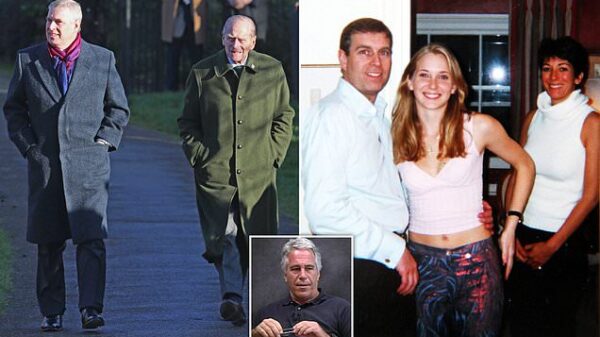
She was photographed walking with Andrew at Balmoral at a moment when any sensible communications team would have managed the optics more carefully.
She drove to church with him publicly in the period after the Newsnight interview — an occasion that was widely read as a deliberate signal of continued support.
When the Newsnight disaster produced the immediate and catastrophic institutional response described in every account of the period, Elizabeth’s management of Andrew was not to require him to step back more comprehensively but to continue managing his situation in the way she had always managed the situations of the children she loved most.
Andrew was, by the consistent account of those who knew the family, Queen Elizabeth‘s favourite child.
The word “favourite” is one that royal biographers use with care, knowing that it is contested and that the principals themselves would deny it.
But the pattern of Elizabeth’s behaviour toward Andrew across his life — her defence of him in the various earlier controversies that had attended his career, her confidence in his judgment on matters about which she should perhaps have been more cautious, her continued association with him at the most public and damaging moment of his crisis — is consistent enough to support the characterisation.
The Daily Beast’s reporting documents the specific ways in which Elizabeth’s courtiers tried to manage the situation after their direct advice was rejected.
They worked through intermediaries.
They managed the scheduling of public events in ways designed to minimise Andrew’s visibility without requiring Elizabeth to make any explicit statement of distance.
They worked with communications professionals to ensure that the palace’s public statements acknowledged the seriousness of the Epstein scandal without directly implicating the Queen’s position.
This management was partially effective in limiting the institutional damage; it was not effective in changing the Queen’s fundamental position.
The broader significance of Elizabeth’s defence of Andrew is what it reveals about the limits of institutional calculation when it comes into conflict with personal loyalty.
Elizabeth was, in most respects, a supremely skilled institutional operator — someone who had spent seventy years managing the monarchy through crises that had repeatedly threatened to damage or destroy it, and who had generally found the right balance between personal feeling and institutional requirement.
The Andrew situation was the exception.
On this one matter — her youngest son, her most defended child, the person she had consistently stood by across a lifetime of smaller controversies — the institutional calculus did not prevail.
The Daily Beast’s reporting notes that Charles’s camp, in the period between Elizabeth’s death and his eventual decision to strip Andrew of his titles, directly attributed the difficulty of the Andrew situation to Elizabeth’s earlier protection of him.
The argument was specific: if Elizabeth had distanced herself from Andrew earlier — if she had accepted the advice her courtiers gave her in 2019 and 2020 — the institutional damage would have been contained sooner, and the subsequent years of managed association would not have been necessary.
Charles, in this reading, was dealing with a problem that his mother had created by refusing to act on advice that was professionally sound and institutionally correct.
This attribution is not entirely fair to the complexities of the situation, but it captures a genuine dynamic.
Elizabeth’s defence of Andrew bought him years of continued royal association that the institutional logic did not support.
It kept him in Royal Lodge, kept his titles intact longer than they might otherwise have been, and maintained the fiction of a manageable situation that the Giuffre lawsuit settlement definitively ended.
The Queen protected her son as long as she could.
When she died in September 2022, the protection died with her.
Charles made his decision five months later.
The shield was withdrawn.
And everything that the shield had been holding back came down.